Search Bar
Billy Joe's Food Farm - ᵀʰᵉʳᵉ ᶦˢ ᶠʳᵉᵉᵈᵒᵐ ᶦᶰ ᵃ ˢᵉᵉᵈ⋅™
  • Food Farm Blog
  • Kid's Blog
  • Home
  • FOR SALE
  • Our Animals
  • Photos From Around the Farm
  • Resources and Websites
  • French Lop Rabbits
    • Rabbits For Sale >
      • Bucks
      • Does
    • Raising Kits: Birth to Weanlings
  • Pet Page
    • Up For Adoption
  • Goats
    • For Sale

Rabbit Enclosure Built With Pallets (And Just In Time, She Had Babies Today!)

4/26/2013

1 Comment

 
Picture

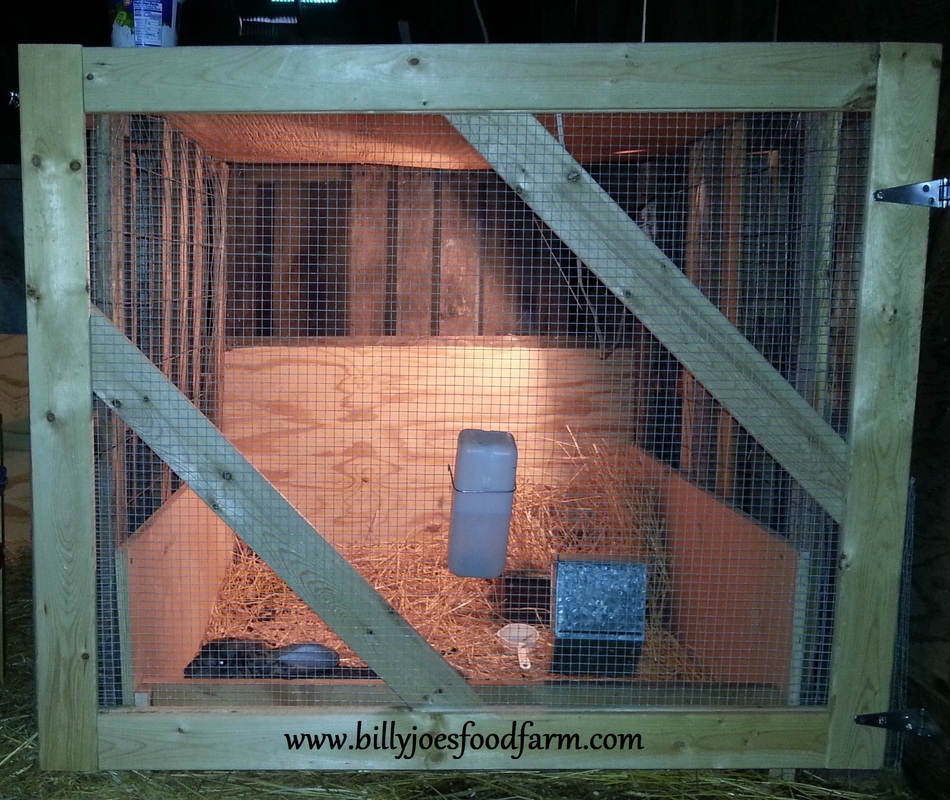
This is the "birthing suite" within our French Lop rabbit enclosure in the barn.  My daughter and I got the front gate done about a week ago, and good thing we did!  This morning I could hear my four month old Anatolian barking and barking and barking, which she also did each time one of our sheep was giving birth.  I thought maybe one of the lambs was out or something, so I go out to the barn to see what was wrong.

I check the soon to be mama bunny, and she has pulled a TON of fur out and put it in her nesting box.  That means birth is imminent.  I didn't see any babies though, and Holly was at the front of her cage pulling more fur.  I go to feed the sheep and goats, and my 12 year old yells at me that Holly has gone to the next box and is having babies!  We actually got to see the babies be born.

So we have seven new little lives here on the farm.  My daughter says it's like Christmas.  :)

1 Comment

Forever Foods: 10 Cooking Staples That Can Outlast You   

4/25/2013

1 Comment

 
Having a stocked pantry is just good common sense.  I like to refer to it as food insurance. 

You have health insurance, car insurance, home insurance, all of those things as IN CASE something should happen.  Even if you live in an apartment in the middle of a huge city and never cook, having dry goods stored so that you can still eat during a crisis, whether caused by storms, terrorism or simply a loss of income, moves you from possible victim to probable survivor.

From mother nature network, a gathering of pantry staples that will last indefinitely when stored correctly.  To this list I would add dried beans, and you would be set if you were snowed in for a month.  Just be sure you have some water stored as well, or a secondary source that is always available to you, even in a power outage.

By the way, water will go stale after having been stored a long time.  If that happens, just pour the water back and forth several times between two containers...that will put oxygen back into the water.  :)

"Could those foods you're getting ready to toss, still be good? Janice
Revell, co-founder of
StillTasty.com, says "Look in your pantry and
your cabinets and check whether the items really do need to go. You'll be
shocked by what you really don't need to throw away."
 
So before you throw out that years-old sugar or replace that bottle of
vanilla that's been gathering dust, consult our list of "forever foods." You may
be surprised how many of your kitchen staples have a shelf life of decades —
even after they've been opened."

See the list here...http://www.mnn.com/food/healthy-eating/photos/forever-foods-10-cooking-staples-that-can-outlast-you/sugar

Picture
1 Comment

(New Post)

4/25/2013

1 Comment

 
Now I can post from my phone!  Let's see how this will work.  Maybe this will make it as easy as posting on the farm Facebook page.
1 Comment

Lessons That I Have Learned

4/23/2013

4 Comments

 
After almost three years of living this homesteading lifestyle, I have learned a valuable lesson;  start small, and dream big.

I have a very bad habit of aquiring animals that I think suit our purposes, before I have their buildings/stalls/fencing/enclosures finished.  I am now in the position of having to sell half of our stock, because I do not have the pastures available to them to forage.  That means that every bit of what they eat has to be purchased, which just isn't practical.  In addition, there does not seem to be much of a market in our area for sheep, which makes it nearly impossible to recoup any money spent feeding them through the year.

The main lessons?  Know your market, know your own strengths and weaknesses, and concentrate your efforts on one or two species.  I am grateful for this experience, and know now that I am simply not the kind of person who can keep a menagerie and still break even, let alone make a profit.  I know some who do, and I applaud them.  But for us, scaling back and rethinking our business plan is our plan of action.  And I will no longer bring any animal to the farm without having the space available for them.

Learning this lifestyle is certainly an ongoing project.  But it is absolutely one that is full of lessons worth learning.

4 Comments

Natural Remedies For Anxiety

4/21/2013

1 Comment

 
I have terrible anxiety issues, so finding ways to deal with it naturally is important to me.  There may not always be a pharmacy around, and even if there is, using plants is better for your body.  Many of these are very easy to grow no matter where you live.  Most will also work if you have trouble sleeping, and who wouldn't love a cup of lavender/lemon balm tea?

Picture
1 Comment

Our Solar Coop Is Featured On Community Chickens

4/20/2013

1 Comment

 
Thanks to Rebecca Nickols for featuring our coop in Community Chickens!

http://communitychickens.blogspot.com/2013/04/cool-coops-solar-power-chicken-coop.html
1 Comment

My Blue Eyed Lamb

4/19/2013

2 Comments

 
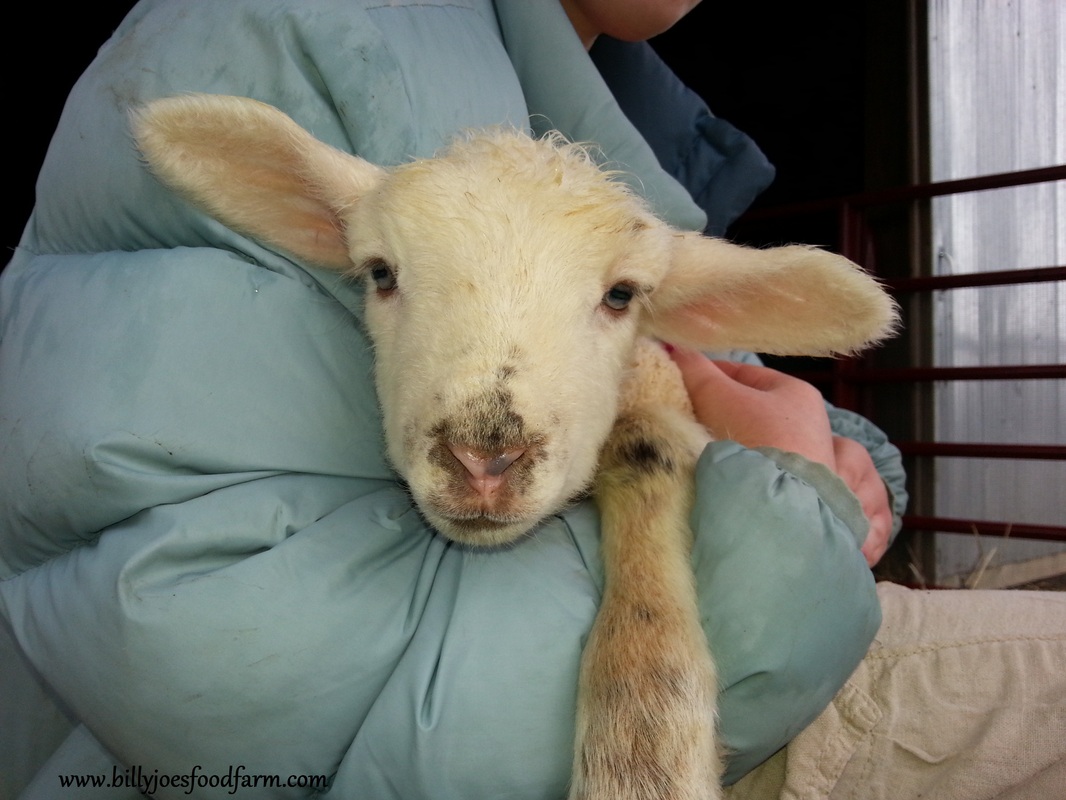
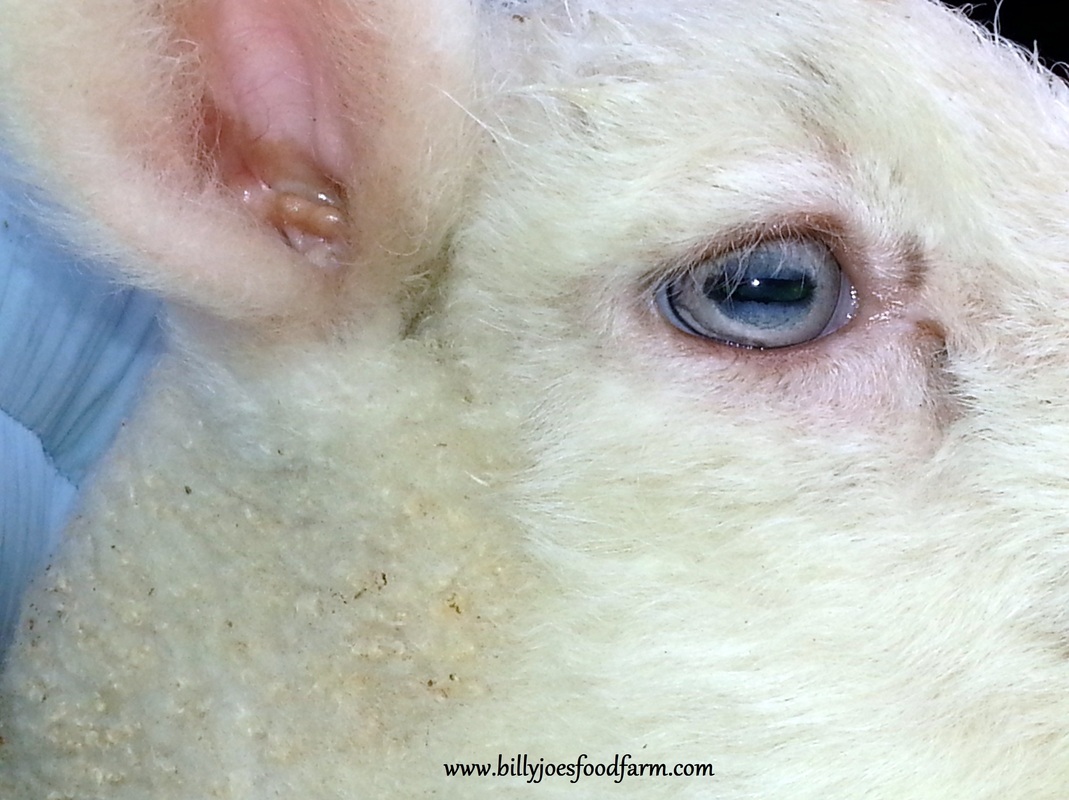
This little ram is only a week old, so his eyes may not stay blue.  But of the three that were born this month, he is the only one to have blue eyes.  Strange, and beautiful.  If they stay blue I may just keep him here.


Picture
Picture
2 Comments

Smaller Gardens For Smaller Spaces

4/18/2013

3 Comments

 
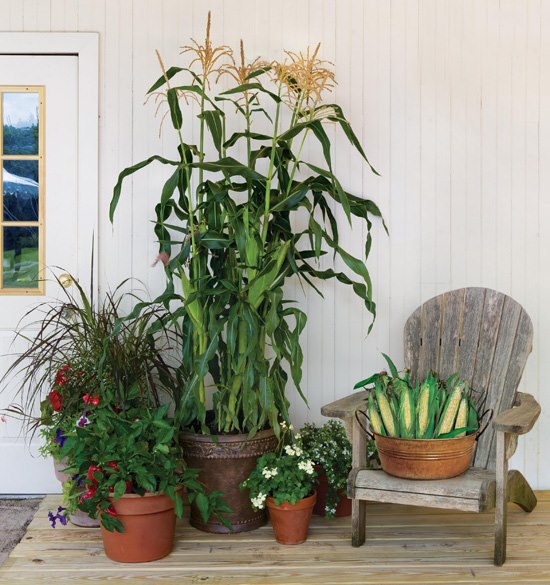
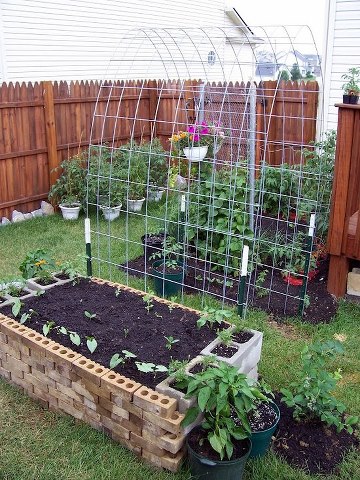
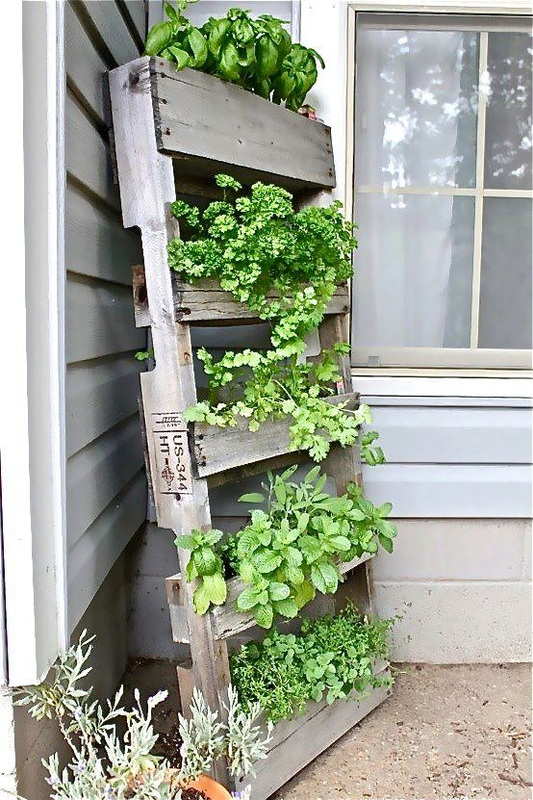
We have at least a few determined readers who live in town, or have no yards, or live in apartments, have health issues and can't manage gardens, etc. I am going to repost today some ideas for gardening in small spaces. It takes just as much work to plant and grow ornamentals as it does food; both are pretty, but for the
work involved, why not get some produce out of the deal?

Below are several ideas that I have found while traipsing around the internet, some I have posted before and some I haven't.  They are all great for inspiration.  Happy Growing!


Picture
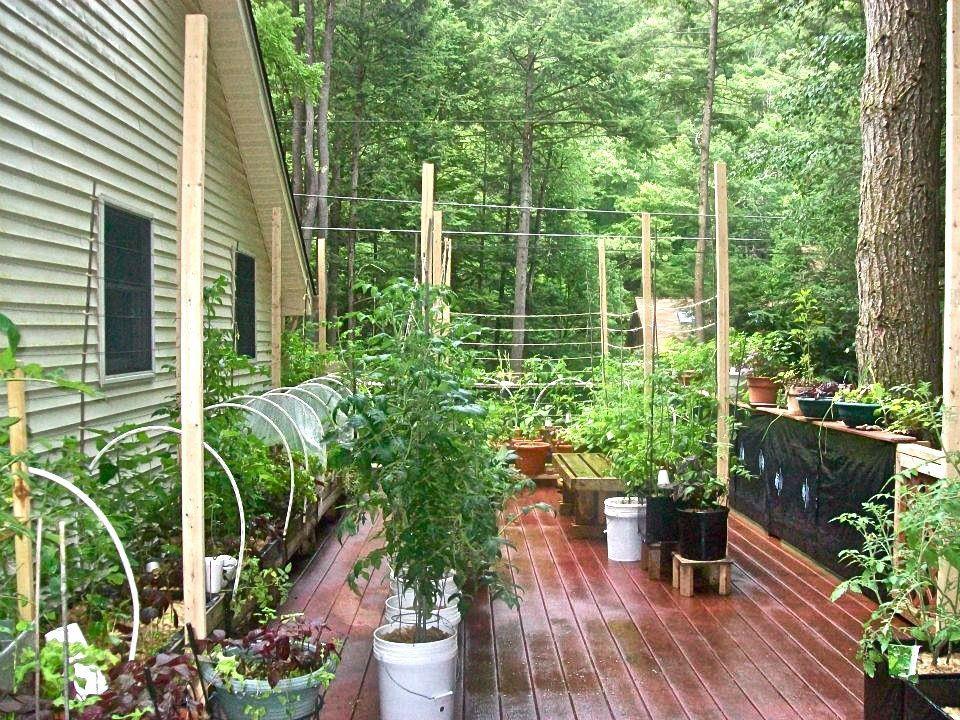
Container Gardening on Your Deck, Patio, or Balcony
Picture
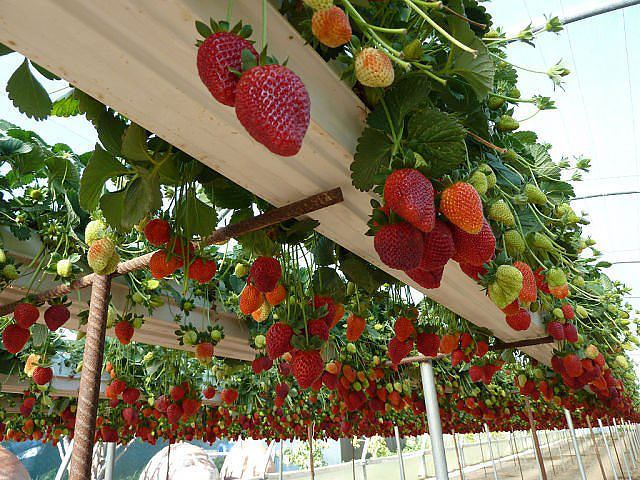
Grow Strawberries, Or Any Other Similarly Sized Plant, In Recycled Guttering
Picture
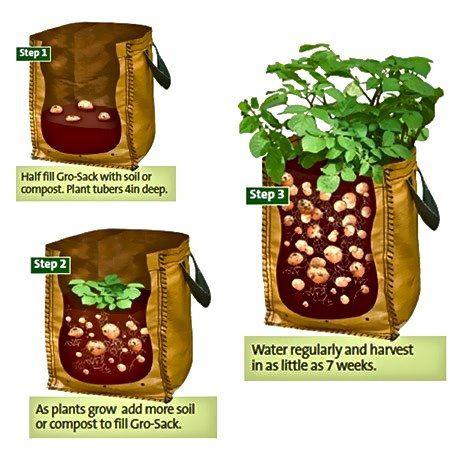
Above is an illustration on how to grow potatoes in a bag; you start at the bottom, and fill with dirt as the plant grows.

However, I want to add a little information to this drawing; it looks like it has the seed potatoes planted whole.  DO NOT plant whole seed potatoes.  You need to cut them in cubes first, with one or two eyes per cube, then let them dry (cure) for two or three days.  If you don't, most of them will rot before you get any food from them.  Then plant them eye up, and back fill dirt as the stalk grows.


Picture
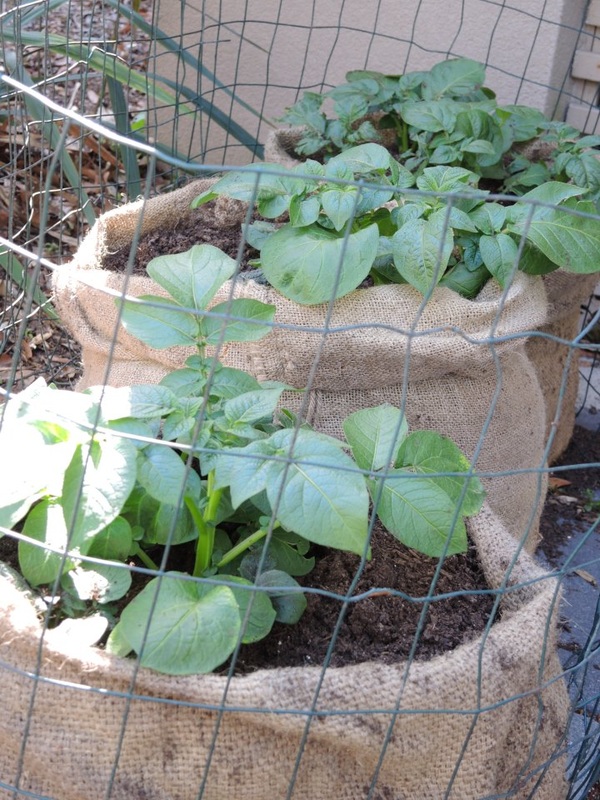
Grow food in a bag.
Picture
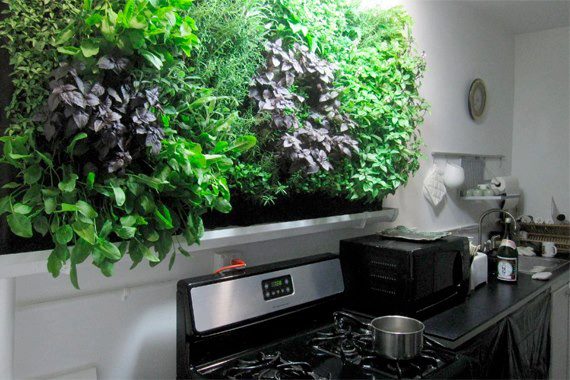
Grow food on your kitchen counter.
Picture
Grow food on your walls.
Picture
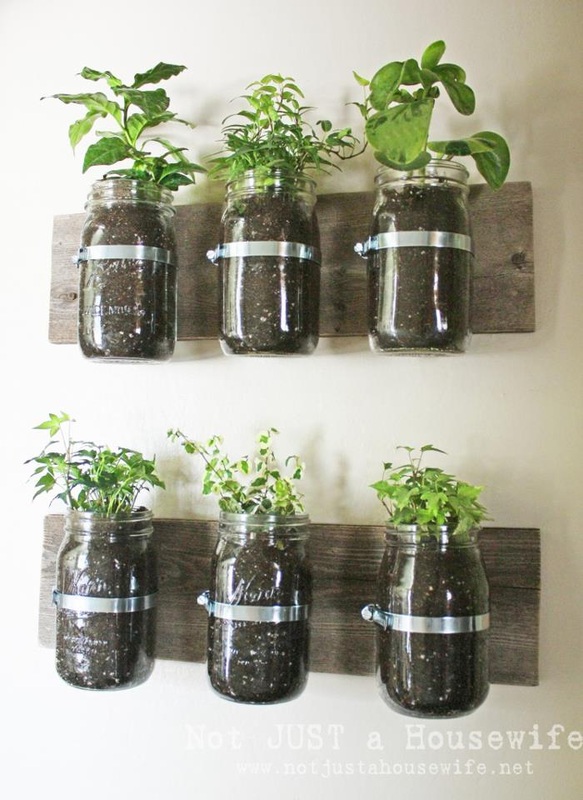
Grow food in pots.
Picture
Be creative and save some money; grow food in small backyards.
Picture
Grow food in pallets.
3 Comments

Our Solar Chicken Coop

4/14/2013

2 Comments

 
*This article was originally posted on December 27, 2012, and has been reworked with more photos and additional information.*

We moved to this property in November of 2010, and it had never been used as a farm with animals.  The back land had been farmed for hay, and twenty five years ago (before the house was built), there were horses kept on the property, but when we bought the place it was not set up for homesteaders. 

Our new place does have a barn that had been used in the past for the horses, but it was wide open on the inside, with no stalls or gates.  The people we bought the place from had used the barn for storage, and had stripped it bare of any livestock keeping capabilites.  We had our work cut out for us to try and build, bit by bit, into self sufficiency.  I figure that might take the rest of our lives.  

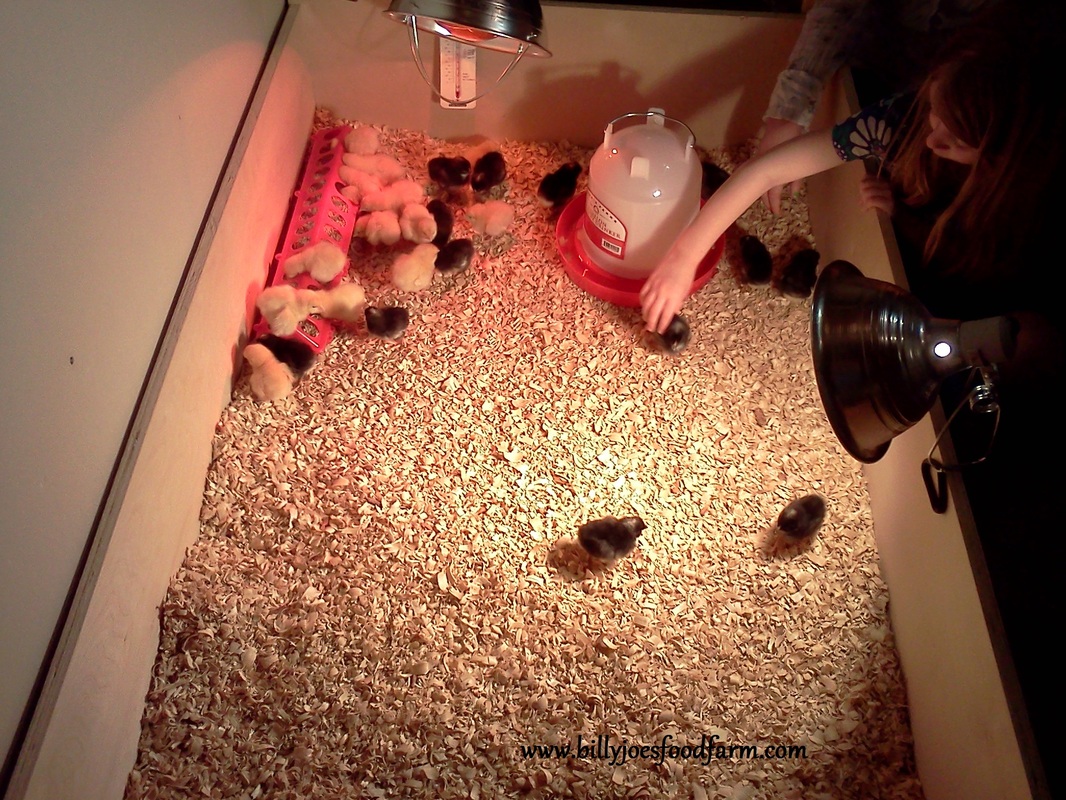
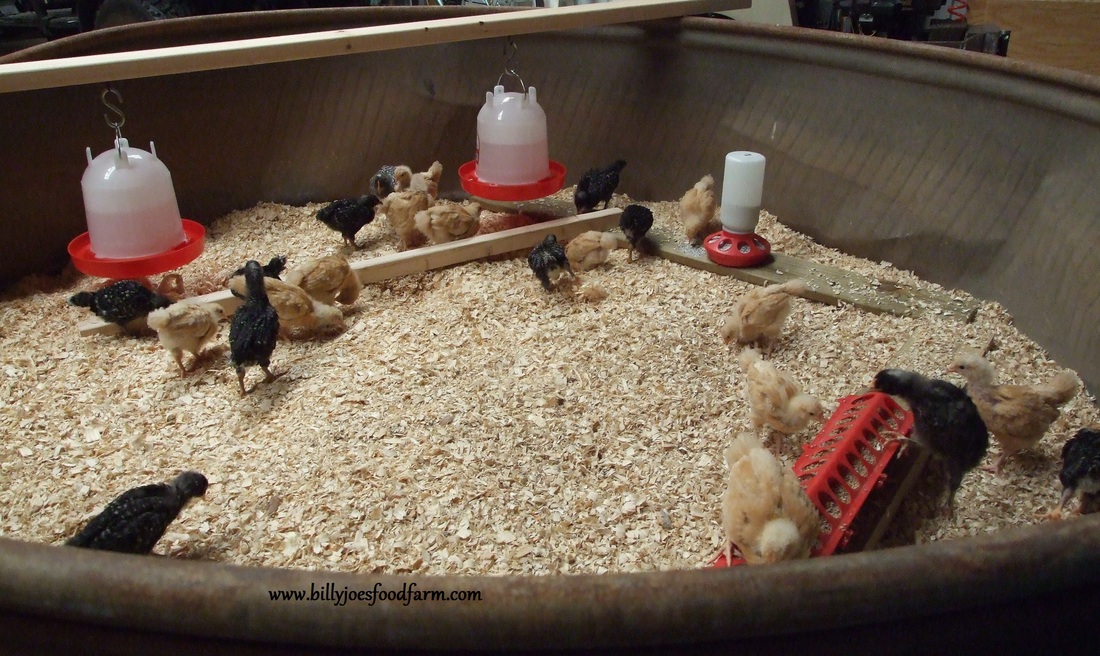
The first animals I purchased were day old chicks; 14 Buff Orpingtons and 13 Barred Plymouth Rocks.  When they arrived of course I had no coop, and it was freezing outside anyway.  We set up an area in
the basement with a heat lamp, some wood chips, and some hastily screwed together pieces of wood to make a rectangle shaped enclosure.  We then got to work figuring out what we wanted for the coop.  I still to this day have a terrible habit of buying the animals that are part of my plan BEFORE I have their enlcosure or fencing done, but I suppose that is another post for another day.

While we were trying to get the coop finished, the birds grew to the point that we could no longer keep them in the house.  We moved them out to the shop, into a big round bale holder that was out in one of the pastures that was here when moved in.  It worked well for the teenaged birds through January and February, and we kept a couple of heat lamps there for them to keep them warm as they finished feathering out.  Toward the end of their stay in the shop, the birds had all their feathers and could fly out of the trough.  As a result, the shop was COVERED in poo; we couldn't get the coop done fast enough.

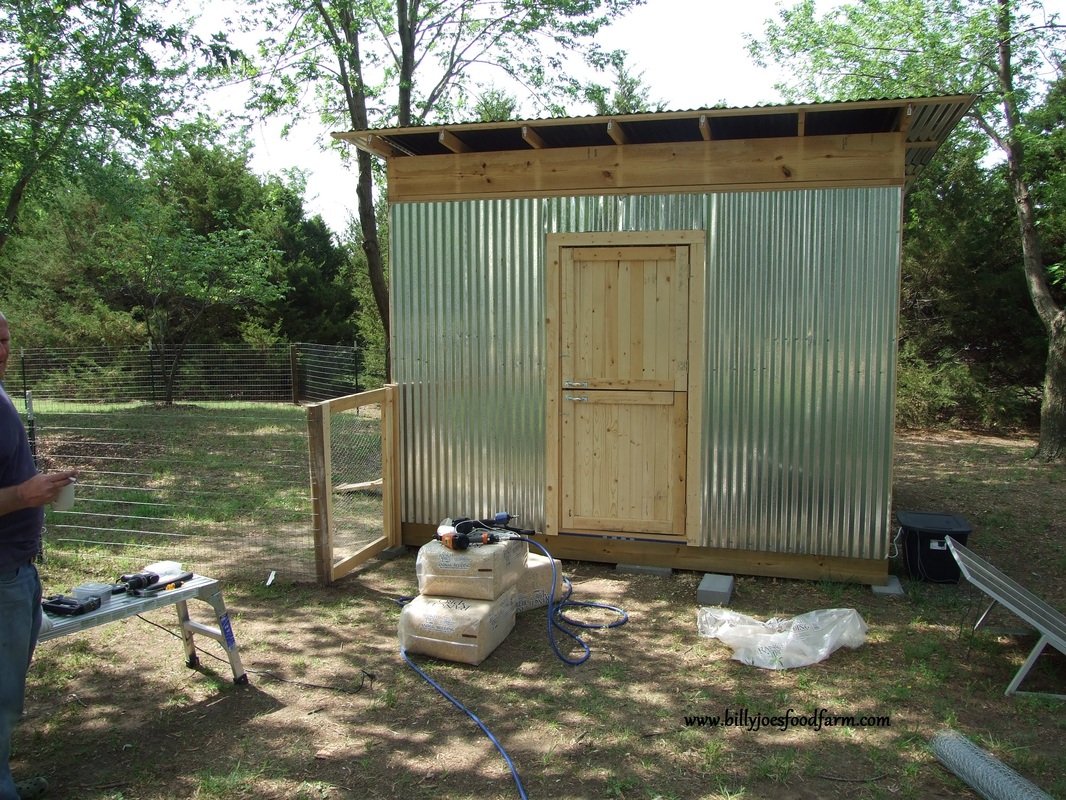
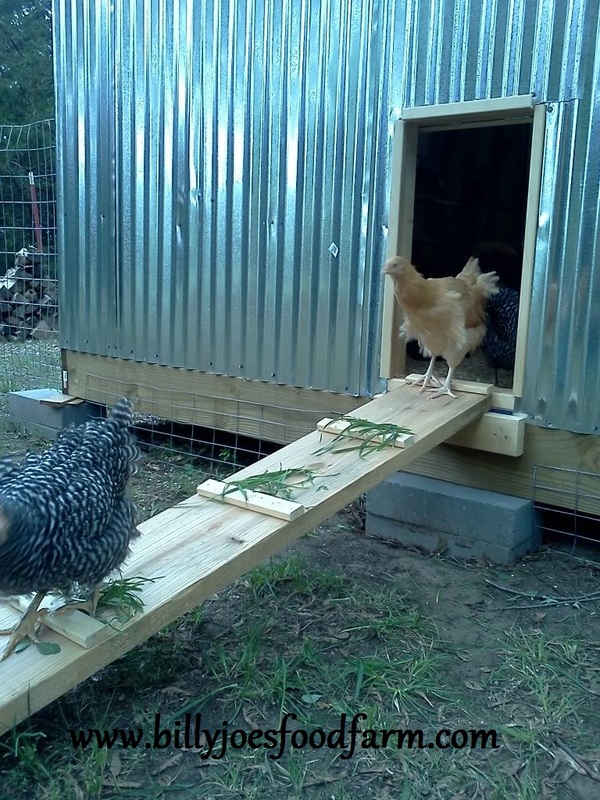
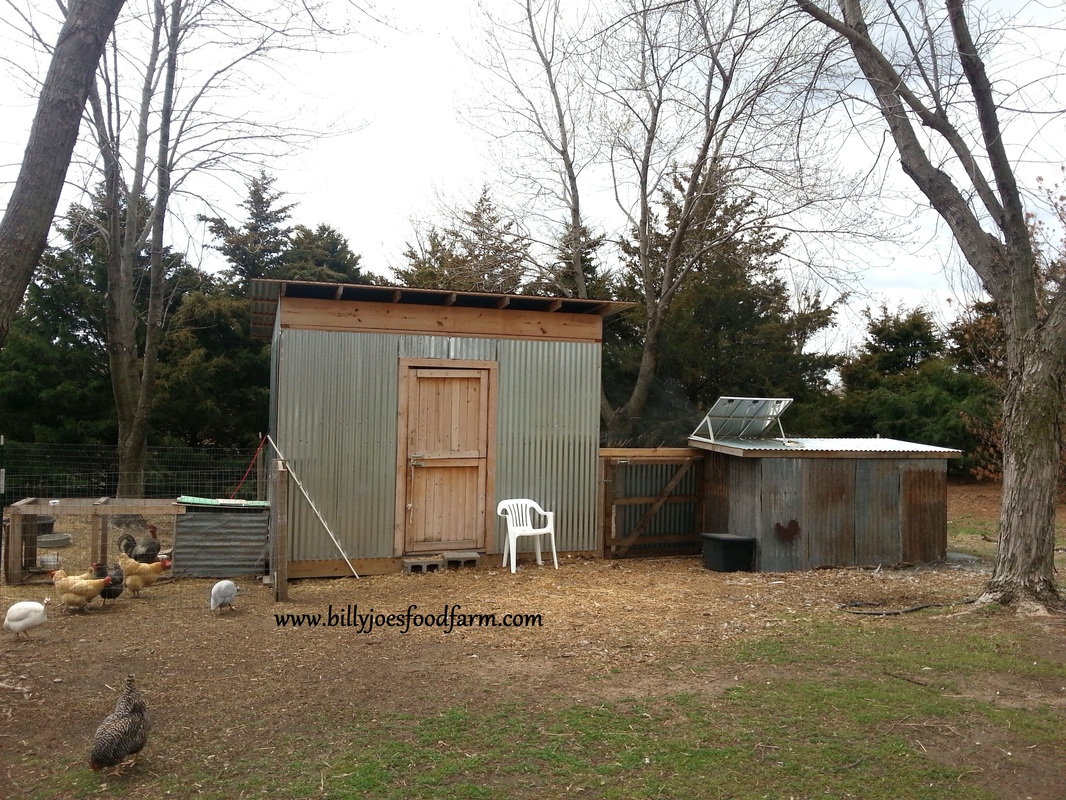
We built our chicken coop off of the ground so digging predators couldn't tunnel into the building, and the walls are metal so snakes can't slither up into it.  The hatch has a lock on the inside, so the raccoons and possums can't raid the joint at night. 

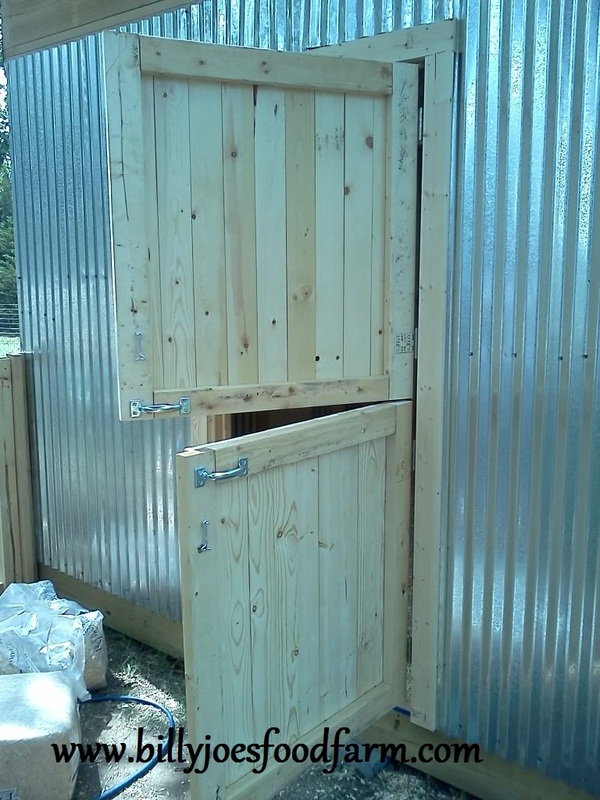
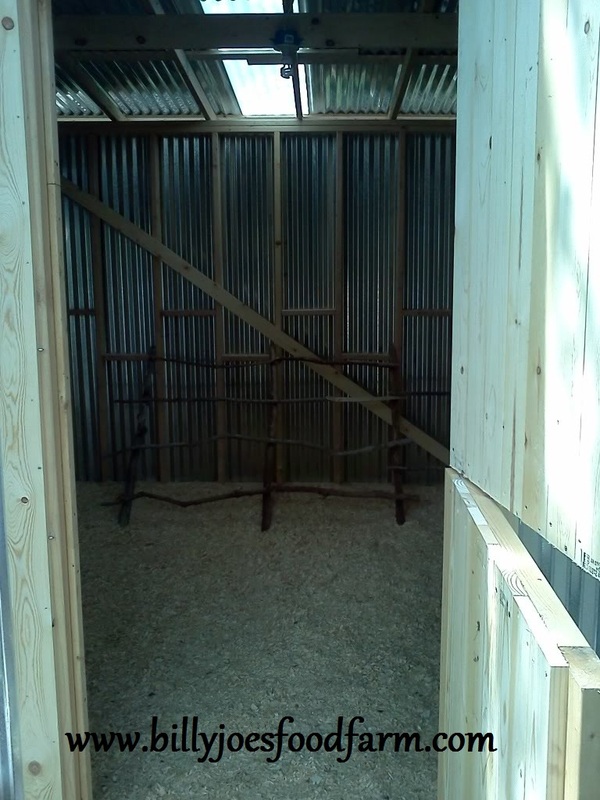
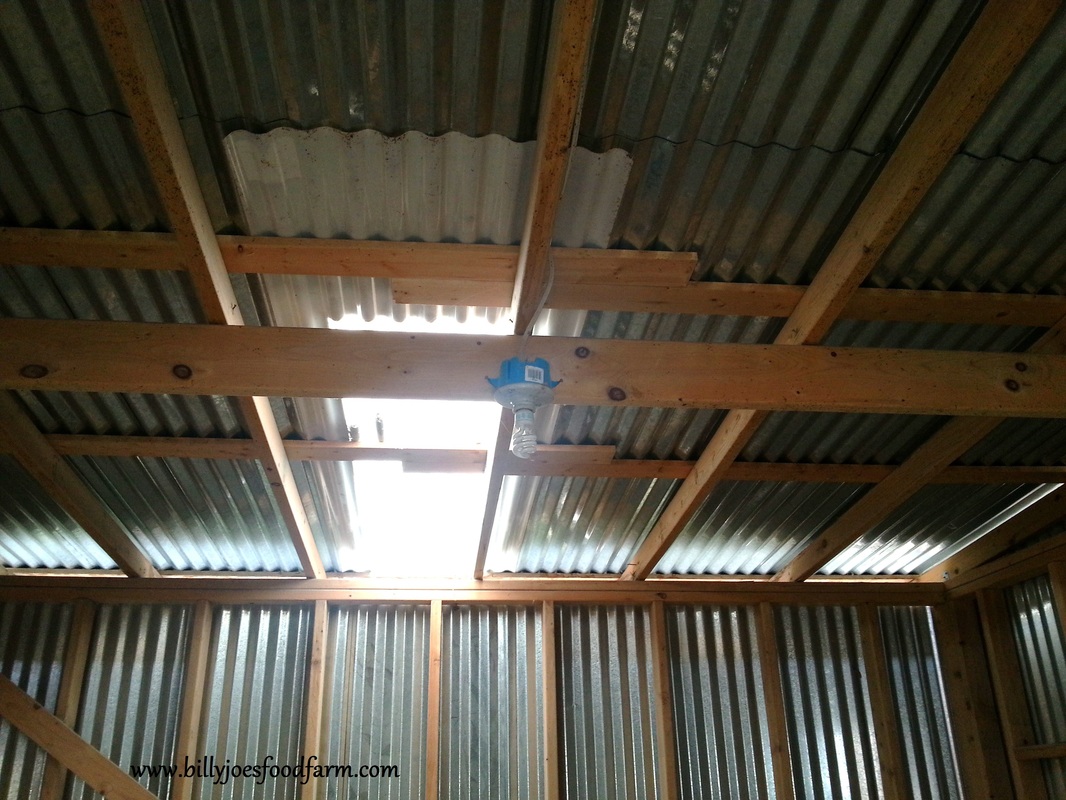
Mr. Food Farm used two pieces of clear corrugated fiberglass in the roof to let light in, and made Dutch doors so that we could check on the birds without letting them out if we needed to do so, or to leave the top half open for ventilation without leaving the entire coop open to would-be egg eaters.  The floor is solid plywood, with some leftover linoleum from our old house on top of the plywood, so that the plywood wouldn't get wet and rot.

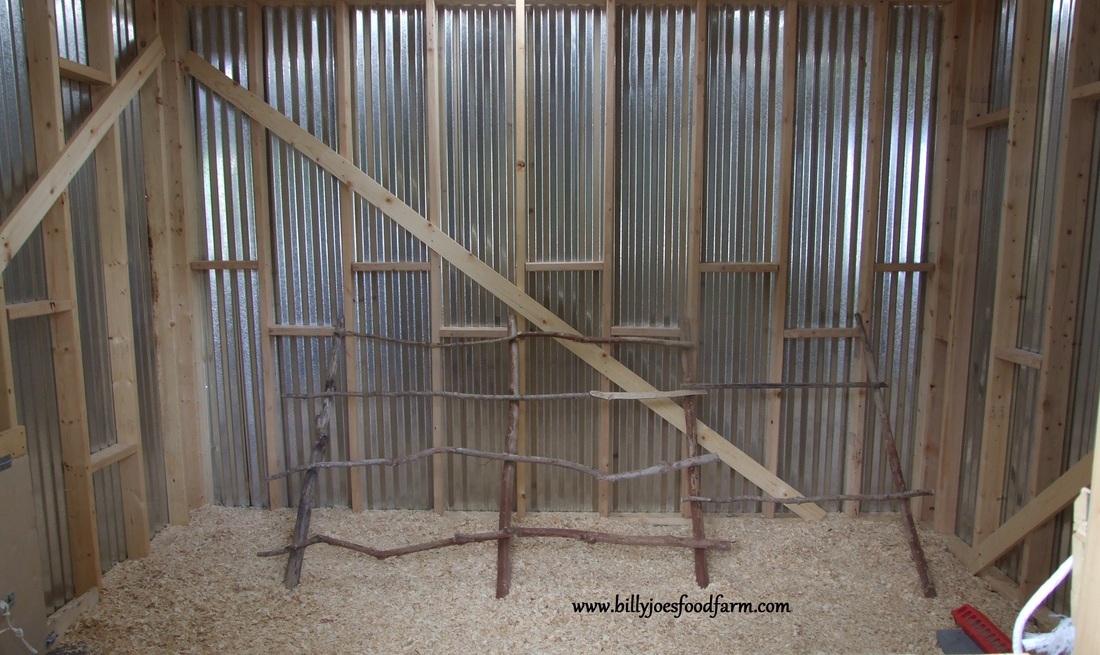
The back ladder style roost is made of a big crepe myrtle that had died and left behind it's perfectly round, smooth branches and trunks.  I have a couple more single rung roosts in two of the corners, as well as a row
of six nesting boxes.

Being interested in self sufficiency lends itself to wanting to be off grid, and we thought a small project to begin with would be a good way to learn.  We decided to install a solar system on our chicken coop, to run a light during the days when sunlight is in short supply.  A hen will lay eggs based on the number of hours of sunlight during the day, which is why they traditionally lay more in summer and less in winter.  If you keep a light in the coop, it tricks them into laying almost all year round. 

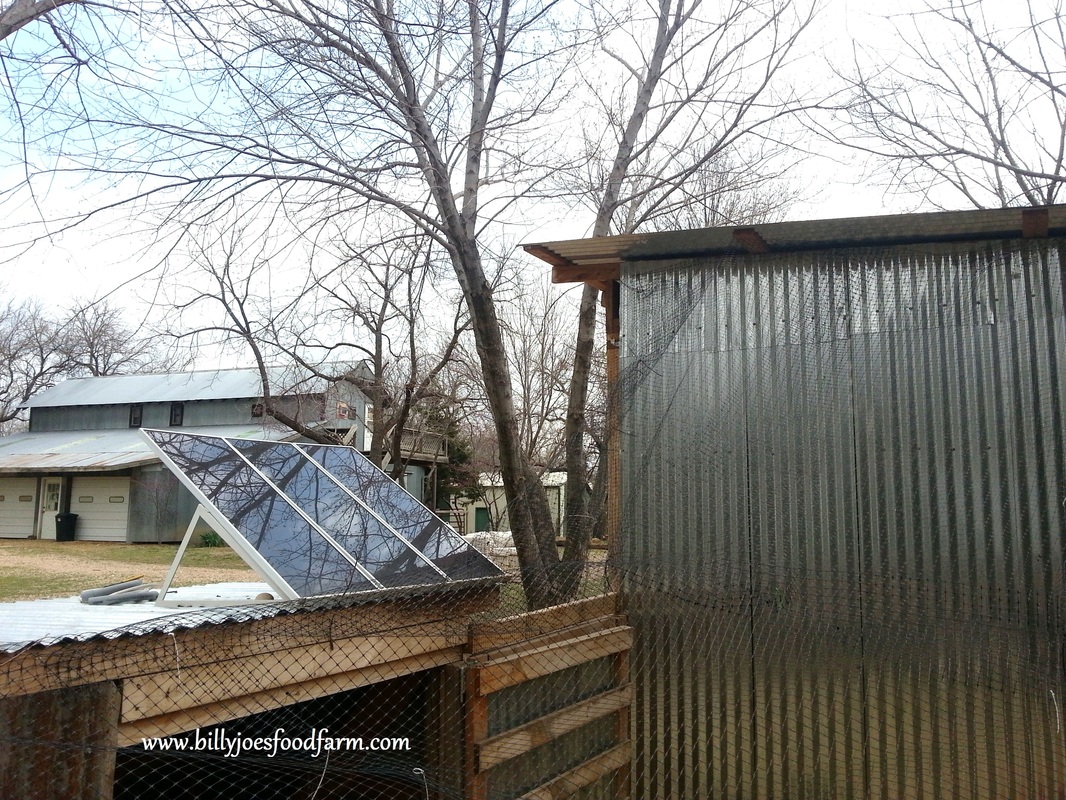
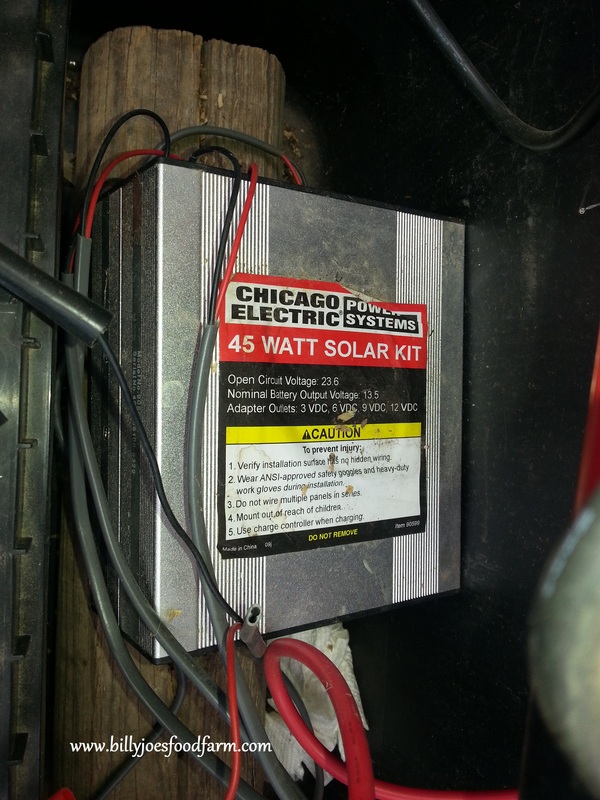
Our system was purchased at Harbor Freight two years ago, and has been running the light in our coop ever since with no problems.  It is a three panel system, each panel putting out 15 watts for a total of 45 watts.  You can add more panels to this, but we have not done so yet.  We have used the power generated by these panels to run the light, a fan during very hot nights, and an electric drill when we were building next door to the coop.  We don't use our system to run a heater for the building or for water; we bought winter hardy chickens so that we wouldn't need a heater, and we also keep ducks in our coop, so no water is allowed in the building or the ducks would have the place flooded.

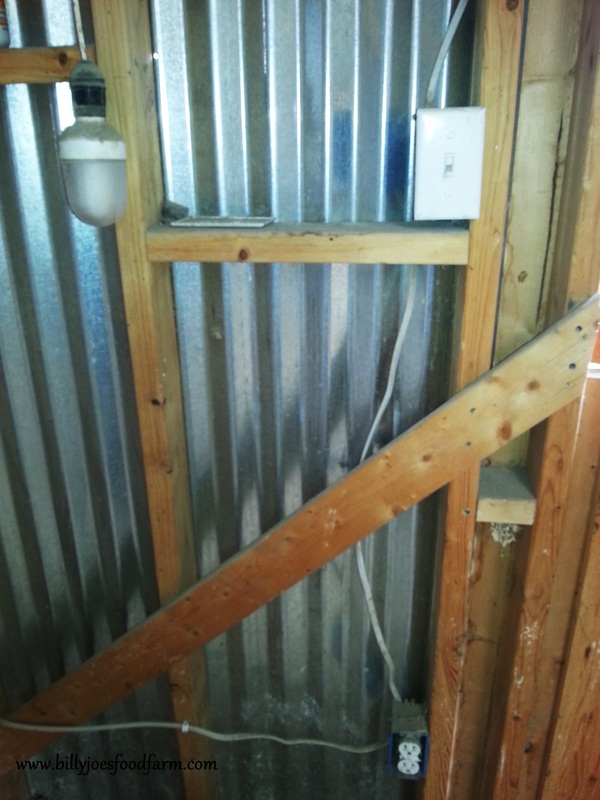
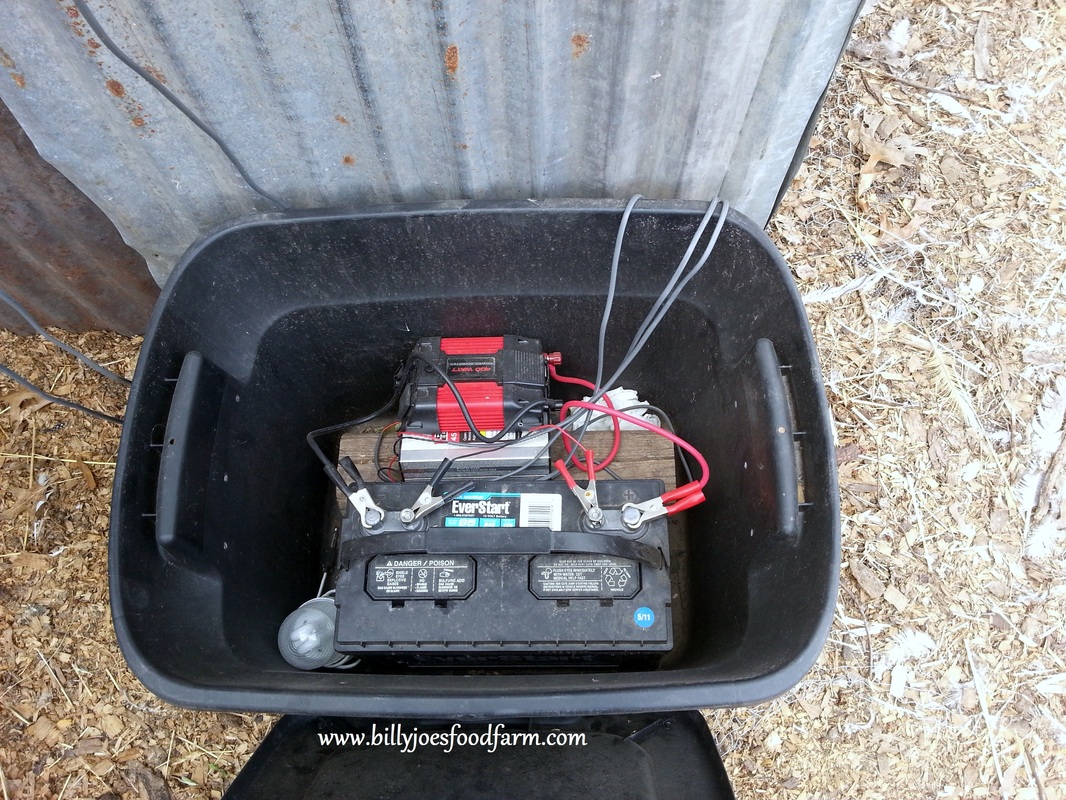
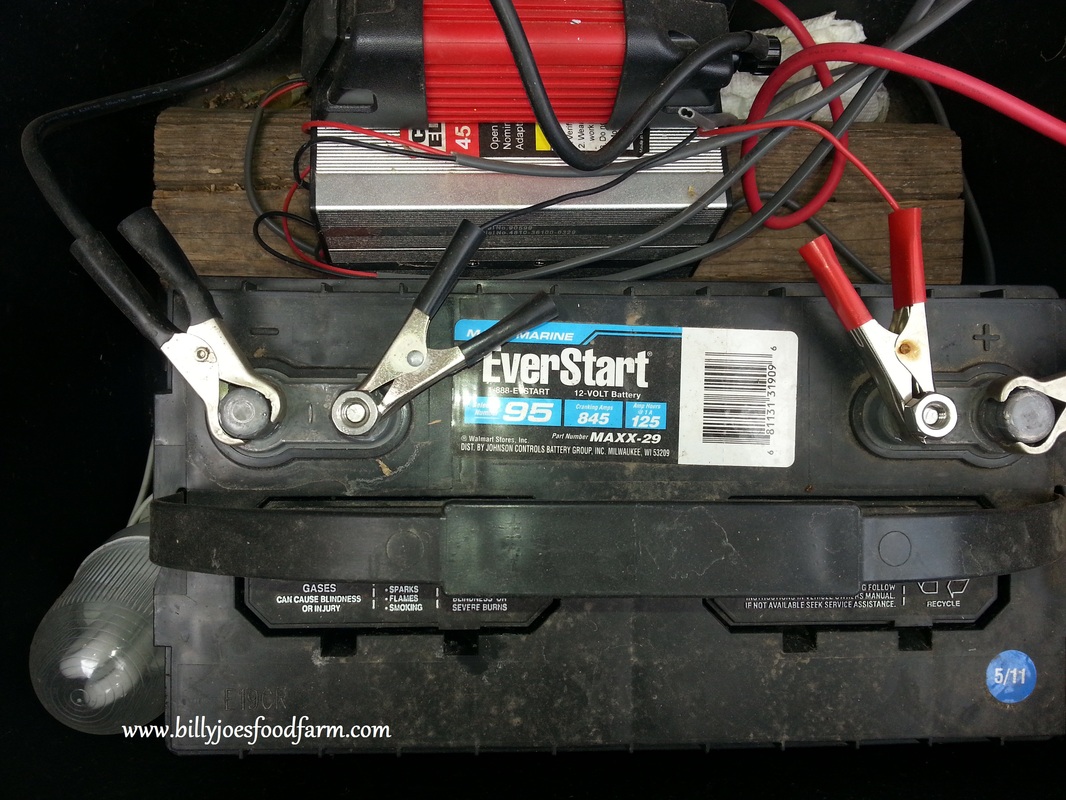
Inside the coop is the light on the ceiling, the switch next to the door that is hard wired to the light, and an outlet that is hard wired as well.  The light fixture is a standard fixture that you can get at any hardware store, as is the electrical wiring, the outlet and the switch.  The only thing that is different about a solar system is that the wiring goes to a plug, rather than a fuse box.  The plug is inserted into a 400 watt power inverter, which we purchased seperately.  The inverter is hooked to the battery, to the positive and negative posts.  The voltage regulator is wired to the battery and to the solar panels. 

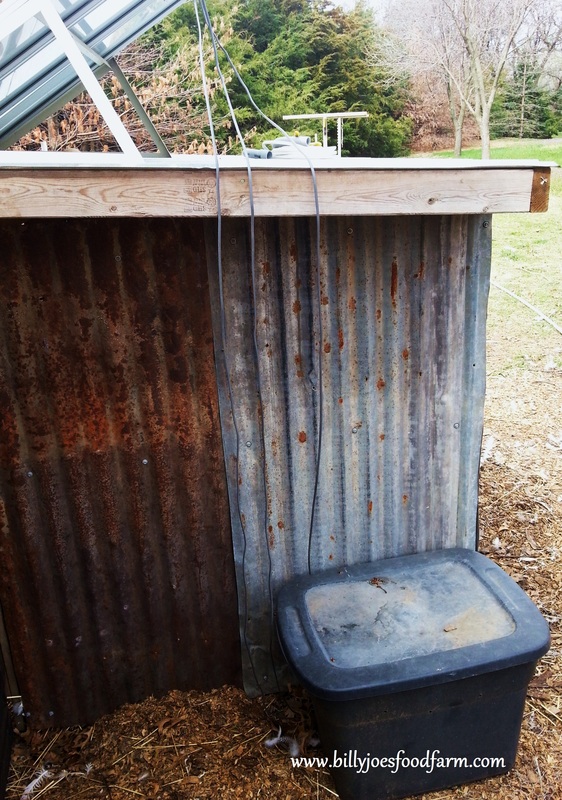
Our three panels are on top of our broody house, which is built next to the coop (although it currently has a mama Nigerian Dwarf goat and her twins, and no birds).  From the panels, wires run down into a black plastic bin, which holds the battery, the inverter and the regulator.  Wiring from the regulator then runs out of the plastic bin to the solar panels.  The panels soak up the sun, the current runs down the wires into the regulator, which is then stored in the battery where it waits until we flip the lightswitch.  When we do, the power in the battery runs into the inverter, which changes the power from DC to AC, then the AC power is run from the inverter into the wiring for the coop via the plug. 

I really don't know much of anything about electricity, or solar power, although I know more now since we installed this unit.  I thought that this small system would be a great introduction for us to get into solar power, and I am really impressed.  We plan to buy more panels in the future, and slowly move over to solar power.  Know that we have dipped our toes into free energy, we are thinking about adding a wind turbine, too.  Being free of an electricty bill is certainly a goal worth working toward, and this system can get you on your way.


Read the reviews of the Harbor Freight solar panel kit here, loads of helpful information from others who have set up this kit for all sorts of uses.  I know there are more knowledgable people there who have left comments that might answer any questions you have about how this kit works, although I will try to do so as well.


2 Comments

Bug Catching; Keep Yourself Comfortable and Your Birdie Friends Well Fed

4/13/2013

1 Comment

 
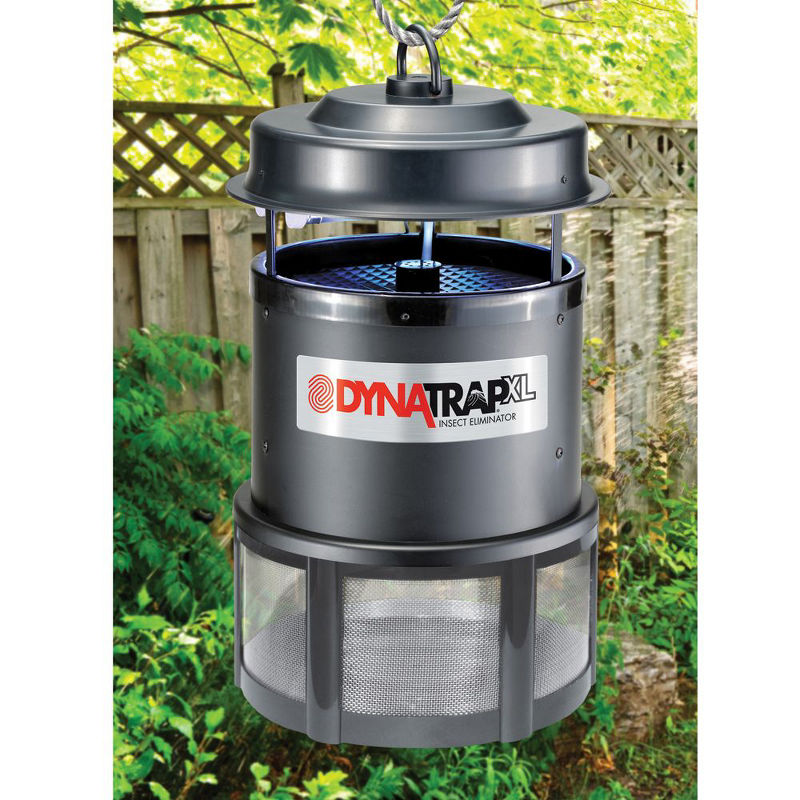
If you want to catch bugs to feed to your birds, without the worry of chemicals or even decay, try this bug catcher.  We bought it years ago when we lived in the city, for mosquitos. 

This contraption catches ALL manner of bugs, and doesn't kill them.  During the spring and summer, this hangs at the far end of our front porch at night, and then the birds get the contents in the morning.  It is a bit pricey, but it serves two purposes (which all things must do around here, at least), and it lasts a very long time.  We have had ours for over five years, and have only had to replace the lightbulbs once.


Picture

You can buy this bug catcher at Hammacher Schlemmer, which is a fantastic company that stands behind their products forever.  Hammacher is American born and raised, has been around since before the civil war, and guarantees whatever you buy for the rest of your life.  I receive nothing for this post, I just really like this little tool.
1 Comment
<<Previous
Forward>>

    Enter your email address:

    Delivered by FeedBurner

    If you like our blog and would like to help support what we do, please feel free to donate any amount to help keep us going!  Our goal is to use this blog to help care for the animals.  We will let you know how your donations are used.  Thank you!
    Billy Joe's Food Farm
    Organic herbs, spices, teas and oils.
    The Enclyclopedia of Country Living is one of THE best homesteading books I have ever purchased, and I still refer to it often.

    RSS Feed

    Author

    We are city folk who decided to move our family to the country, to experience life the way it ought to be lived...OUTSIDE! 

    Categories

    All
    Butchering
    Chickens
    Ducks
    Food As Medicine/Herbal Medicine
    Food Security
    Gardening
    Gmo
    Goats
    Heirloom Seeds
    Herbal Resources
    Homesteading
    Rabbits
    Self Reliance
    Sheep

    Archives

    February 2014
    November 2013
    July 2013
    June 2013
    May 2013
    April 2013
    March 2013
    February 2013
    January 2013
    December 2012
    November 2012
    May 2012
    April 2012
    March 2012
    February 2012

    Shop Amazon's Kindle Accessories Store
    Search & Win

Billy Joe's Food Farm 

  Raising sheep, goats, chickens, guineas, ducks, dogs, cats, and gardens since 2010.  Oh, and not eating anything but plants and fish.  Welcome!

    Contact Us

Submit
Proudly powered by Weebly