I have decided that my daughter Grace will no longer run the kids blog here at Billy Joe's Food Farm. Her writing has progressed to the point that it is well written, as well as funny, so she and I both will be posting here.
I hope you enjoy her posts! Click on the link above to the Kids Blog to read her previous
- Tina
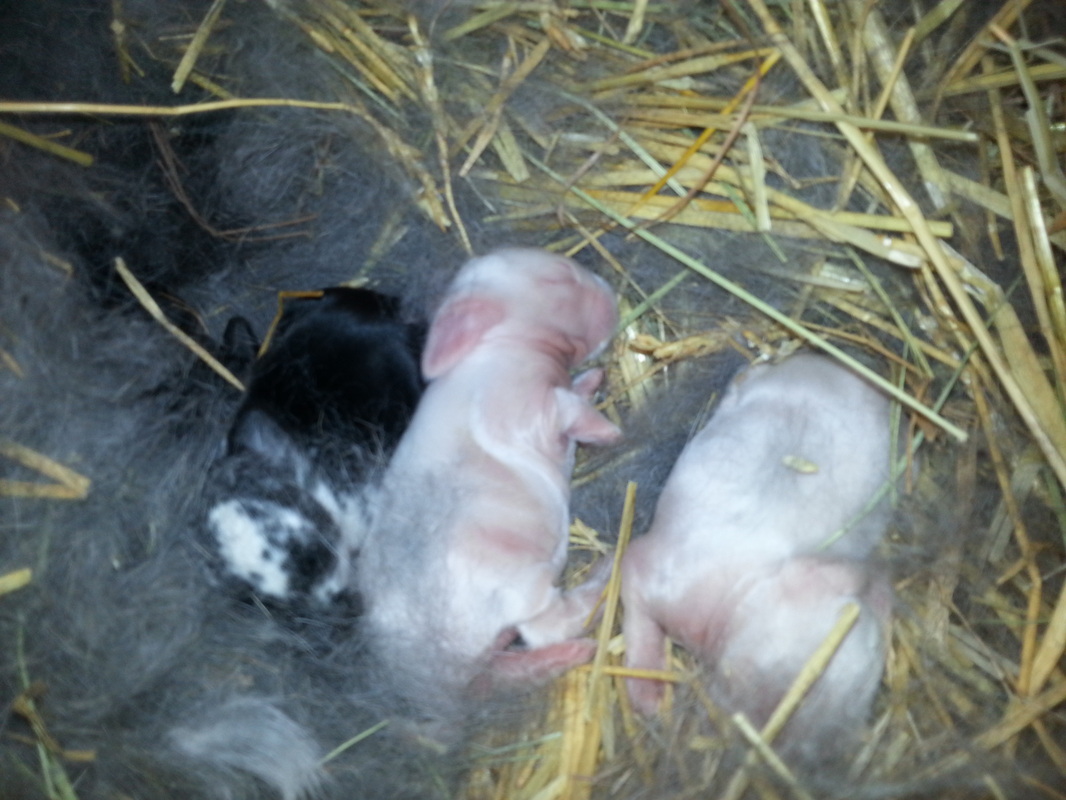
Something killed my male duck, and the mama rabbit ate the runt of her litter that was born yesterday.
I really didn't think the runt was going to make it to adulthood because he was so much smaller than the rest, but it still makes me sick. Keeping rabbits is really not very high on my desired list of activities, because they are really fairly bad parents.
I'm feeling guilty about my duck, because I built the little coop he as in, and I put him in there; he was being too hard on one of my female ducks and I wanted to give her a break. I'm guessing it as a raccoon, because of the way it was killed (which as particularly brutal), and because the attacker would have had to climb the fence to the bird yard and it was strong enough to bust out one of the boards to get to this duck. Kind of a crappy morning around here.
This is the "birthing suite" within our French Lop rabbit enclosure in the barn. My daughter and I got the front gate done about a week ago, and good thing we did! This morning I could hear my four month old Anatolian barking and barking and barking, which she also did each time one of our sheep was giving birth. I thought maybe one of the lambs was out or something, so I go out to the barn to see what was wrong.
I check the soon to be mama bunny, and she has pulled a TON of fur out and put it in her nesting box. That means birth is imminent. I didn't see any babies though, and Holly was at the front of her cage pulling more fur. I go to feed the sheep and goats, and my 12 year old yells at me that Holly has gone to the next box and is having babies! We actually got to see the babies be born.
So we have seven new little lives here on the farm. My daughter says it's like Christmas. :)
Having a stocked pantry is just good common sense. I like to refer to it as food insurance. You have health insurance, car insurance, home insurance, all of those things as IN CASE something should happen. Even if you live in an apartment in the middle of a huge city and never cook, having dry goods stored so that you can still eat during a crisis, whether caused by storms, terrorism or simply a loss of income, moves you from possible victim to probable survivor. From mother nature network, a gathering of pantry staples that will last indefinitely when stored correctly. To this list I would add dried beans, and you would be set if you were snowed in for a month. Just be sure you have some water stored as well, or a secondary source that is always available to you, even in a power outage. By the way, water will go stale after having been stored a long time. If that happens, just pour the water back and forth several times between two containers...that will put oxygen back into the water. :)
"Could those foods you're getting ready to toss, still be good? Janice Revell, co-founder of StillTasty.com, says "Look in your pantry and your cabinets and check whether the items really do need to go. You'll be shocked by what you really don't need to throw away." So before you throw out that years-old sugar or replace that bottle of vanilla that's been gathering dust, consult our list of "forever foods." You may be surprised how many of your kitchen staples have a shelf life of decades — even after they've been opened."
See the list here...http://www.mnn.com/food/healthy-eating/photos/forever-foods-10-cooking-staples-that-can-outlast-you/sugar
Now I can post from my phone! Let's see how this will work. Maybe this will make it as easy as posting on the farm Facebook page.
After almost three years of living this homesteading lifestyle, I have learned a valuable lesson; start small, and dream big.
I have a very bad habit of aquiring animals that I think suit our purposes, before I have their buildings/stalls/fencing/enclosures finished. I am now in the position of having to sell half of our stock, because I do not have the pastures available to them to forage. That means that every bit of what they eat has to be purchased, which just isn't practical. In addition, there does not seem to be much of a market in our area for sheep, which makes it nearly impossible to recoup any money spent feeding them through the year.
The main lessons? Know your market, know your own strengths and weaknesses, and concentrate your efforts on one or two species. I am grateful for this experience, and know now that I am simply not the kind of person who can keep a menagerie and still break even, let alone make a profit. I know some who do, and I applaud them. But for us, scaling back and rethinking our business plan is our plan of action. And I will no longer bring any animal to the farm without having the space available for them.
Learning this lifestyle is certainly an ongoing project. But it is absolutely one that is full of lessons worth learning.
I have terrible anxiety issues, so finding ways to deal with it naturally is important to me. There may not always be a pharmacy around, and even if there is, using plants is better for your body. Many of these are very easy to grow no matter where you live. Most will also work if you have trouble sleeping, and who wouldn't love a cup of lavender/lemon balm tea?
This little ram is only a week old, so his eyes may not stay blue. But of the three that were born this month, he is the only one to have blue eyes. Strange, and beautiful. If they stay blue I may just keep him here.
We have at least a few determined readers who live in town, or have no yards, or live in apartments, have health issues and can't manage gardens, etc. I am going to repost today some ideas for gardening in small spaces. It takes just as much work to plant and grow ornamentals as it does food; both are pretty, but for the work involved, why not get some produce out of the deal?
Below are several ideas that I have found while traipsing around the internet, some I have posted before and some I haven't. They are all great for inspiration. Happy Growing!
Container Gardening on Your Deck, Patio, or Balcony
Grow Strawberries, Or Any Other Similarly Sized Plant, In Recycled Guttering
Above is an illustration on how to grow potatoes in a bag; you start at the bottom, and fill with dirt as the plant grows. However, I want to add a little information to this drawing; it looks like it has the seed potatoes planted whole. DO NOT plant whole seed potatoes. You need to cut them in cubes first, with one or two eyes per cube, then let them dry (cure) for two or three days. If you don't, most of them will rot before you get any food from them. Then plant them eye up, and back fill dirt as the stalk grows.
Grow food in a bag.
Grow food on your kitchen counter.
Grow food on your walls.
Grow food in pots.
Be creative and save some money; grow food in small backyards.
Grow food in pallets.
|